
The Speed of AI
The Speed of AI
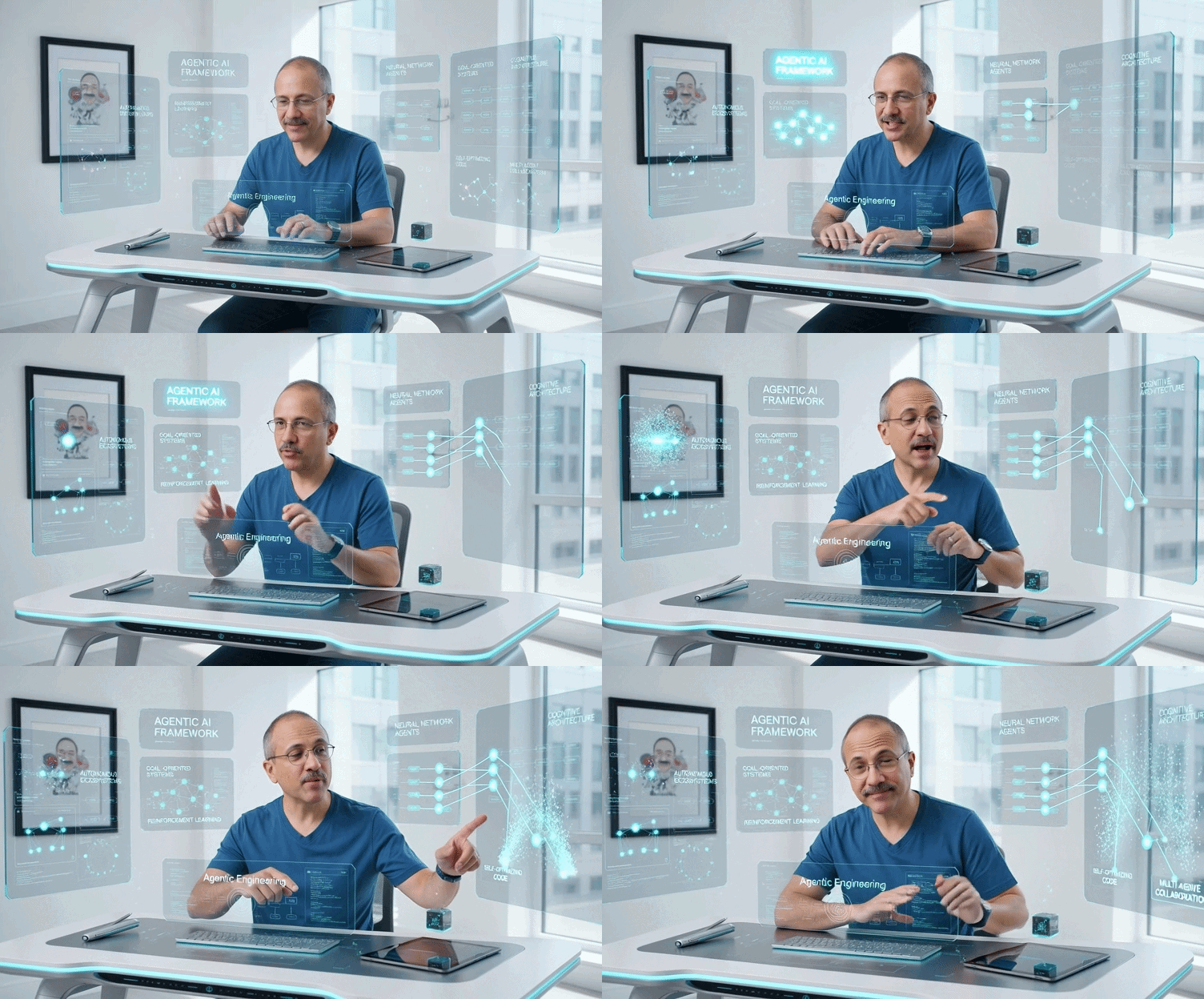
I felt it was time to sit down and put together a few thoughts about where I think AI is, where it’s going, and how fast it’s coming based on all the signals I’ve been seeing.
I started digging in deep last summer, July 18th, 2025 at 7:02am to be specific. I had played a bit with ChatGPT but hadn’t really done anything serious with it as I was busy working on projects all day like everyone else. The project I was on came to an end and I had free time starting on that day to start digging in deep so I dove in to learn.
I didn’t sleep well that night. After a long day of play - 7:00am to 11:00pm - I had realized that many aspects of my work were easily replaceable with a well-constructed prompt. At first, that scared the heck out of me which is why I didn’t sleep well for the next two weeks. But, then I embraced it - imagine how fast I could go with this new and amazingly powerful tool.
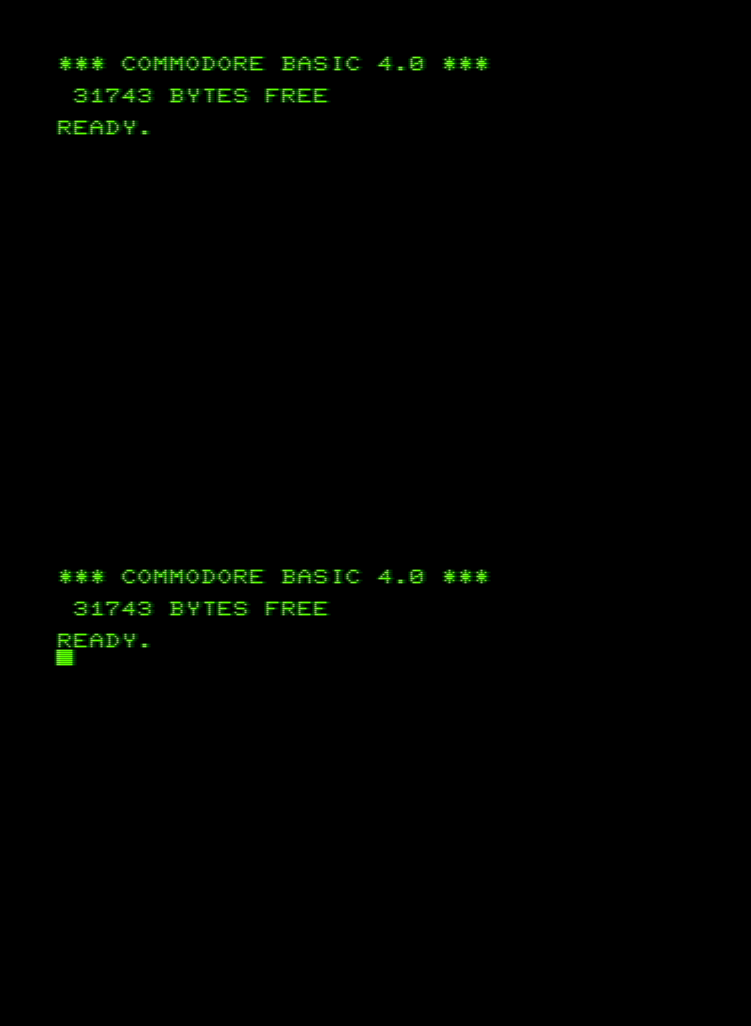
First, for those who don’t know my background, you should know that I initially started working with computers, the Commodore Pet specifically, in 1982 at Halifax West High School as part of Mr. Boyles’ grade 10 honours math class. My first experience in September of 1982 was to turn on the computer. Under the green “READY.” prompt I typed “Help.” and hit the enter key. The computer responded with “?Syntax Error”. Thinking I may have broken something, I did the obvious: I turned it off and back on again. At the next READY prompt I typed “Give information” and again I was met with “?Syntax Error” so I turned the computer off and left.
Since then I spent 43 years programming in 20+ different languages on multiple platforms and environments, I designed and built a CMS called iWeb Suite for immediaC which was used by hundreds of clients, I managed a variety of IT infrastructure and performed a ton of architecture work along with a fair bit of work in both the IT privacy and security spaces. All that is to say that I know a lot about the IT world.
One of the tasks of an Enterprise or Solution Architect might perform for example is to run Fit-Gap analysis between a set of requirements for a solution and a set of capabilities provided by various products and/or components to ensure the solution will be fit for purpose and also fit within the organization and its future needs all while optimally solving the business problem at hand.
I realized my career, as well as the careers of many, were in danger when I was able to turn what would normally have taken 3 or 4 days of effort to generate one of these Fit-Gap analyses into a 15-20 minute exercise with the right prompt and source materials. Knowledge workers were going to be replaced by AI and a well-structured prompt. It seemed obvious to me at that point.
The only “advantage” I still had was that it took me, as an architect, to provide the correct context and instructions as the part of the prompt in order to generate the correct output I needed to deliver to the client. The AI couldn’t figure that part out by itself - at least not yet. I was still positive we were all going to be unemployed by Christmas because even though it wasn’t perfect, it was, in my opinion at the time, close enough to be very successful at performing a lot of work and getting better every day.
I got Christmas wrong. I hadn’t spent enough time in the AI space to know that what I was seeing as an amazing step forward that was going to change the world, most people were ignoring because they didn’t have enough time to be paying close enough attention, there’s a very important word, to where we were on the AI technology curve and in many ways that’s still the case.
Since then I’ve watched Gemini 3 and Nano Banana come out last November from Google and blow the doors of everything that was already in the market which I already knew could replace me. Right behind that was Claude Opus 4.5 which was a level up in coding yet again. Next was GPT 5.2 from OpenAI. Things were moving fast!
Then, in less than 3 months, they’ve all upgraded again and the models got better and they’ve started adding more model features. I watched Nate B. Jones’ video today and he sums up some of the recent key features of improvements being somewhat consistent across 4 different company stacks as Decompose, Parallelize, Verify, and Iterate which is smoothing out the jagged edge of AI capabilities making them more useful.
First as a programmer, and then as an Enterprise Architect, the skills I’ve been developing my whole life are to help see the scope of a problem, break it down into easily solvable components and reconstruct a fit-for-purpose solution. I saw this last summer as the inevitable next step in AI-based software generation when I was first just copy/pasting code out of browser windows into an IDE.
And I didn’t need to see Nate’s video today to also have noticed the changes to the AI coding tools as they’ve been beefing up the harness that supports the generation. I’ve been using the tools daily and watching the improvements as they are being made. Not just the model improvements but the way the tools attack the problem has been changing.
VibeCoder or Agentic Engineer
I don’t know if you would call me a VibeCoder or an Agentic Engineer, but what I do know is that with tools like Claude Code and AntiGravity I’ve been able to build things like never before and I know I am only scratching the surface of what the leaders in this space are doing. The power I can bring to bear today compared to last July - or even last October - is amazing.
While I only have less than a year of dedicated AI study, that’s on top of 43 years of programming and working with computers. That experience offers me a well-informed perspective of the state of AI today. Based on my deep background and study, the only rational prediction is to say I have no idea where we are headed or when we’ll get there and I think that should grab your attention (remember that important word) just a little bit.
When I said I don’t know where things are going, I was being a bit facetious. While I don’t believe anyone knows where the future will take us in any detailed way, based on what I have been seeing, I truly believe AI will permeate our lives and become as ubiquitous to us as a TV or mobile phone is today and not be relegated to just the programmers and chatbots.
Ultimately, you are the hero in your own journey and you have to choose your own path to the future. I share this information with you as I would recommend figuring out how AI fits into that future by putting some of that very valuable commodity of attention on it so you can begin to learn how it fits (or doesn’t) in your world.
I think the most important skills to develop in the coming years are not technology skills but instead communication skills and the ability to adapt to change. Upon reflection, these skills have always been the most important skills to develop.
Our ability to communicate both with others so we can understand the business problem that needs to be solved and with AI Agents so we can provide the correct information, context and data to deliver a solution will serve you well regardless of the solution that needs to be delivered.
We need to be adaptable because the tools are changing rapidly. What was almost impossible a few months ago, is almost a trivial exercise now. The tools I started with back in July have all been replaced by a new set of tools that outclass every tool I was using back then. Learn to explore so you can move when needed to make use of the tools that are available.
The final but most important skill to develop is the skill of curiosity. Curiosity is a skill that keeps you moving forward to learn more every day. Curiosity is driven by “What if I did this?” and “I wonder if I could?”. So, I implore you to stay curious and spend some attention on AI.
Domo arigato gozaimashita.